The post Which IoT protocol do I use? Here is the answer appeared first on akorIoT.
]]>Which IoT protocol do I use?
Very recently a significant new customer has asked us to design a combined LoRaWAN / Cellular (LTE-M/ NB-IoT) board. Cellular is pretty new.
Q: I am currently selecting a suitable cellular modem. The idea is that we will run sensor applications on a specific (STM32L4… ) MCU, which will communicate with either a cellular modem or LoRaWAN modem via an AT serial interface (not simultaneously). This is a departure from the single MCU application + LoRaWAN stack that we use now.
Part of the design is of course identifying an application-level protocol. There is one discussion on your site where you recommend CoAP for NB-IoT. We will be starting with LTE-M, using NB-IoT a bit later. Rather than CoAP (which I’ve used before) there is another choice now MQTT-SN over UDP, which is being promoted extensively by one manufacturer at least. As a fan of MQTT anyway, going the MQTT-SN route looks like a really good fit.
So I was interested if you had any thoughts on using that over CoAP?
IoT protocol comparison
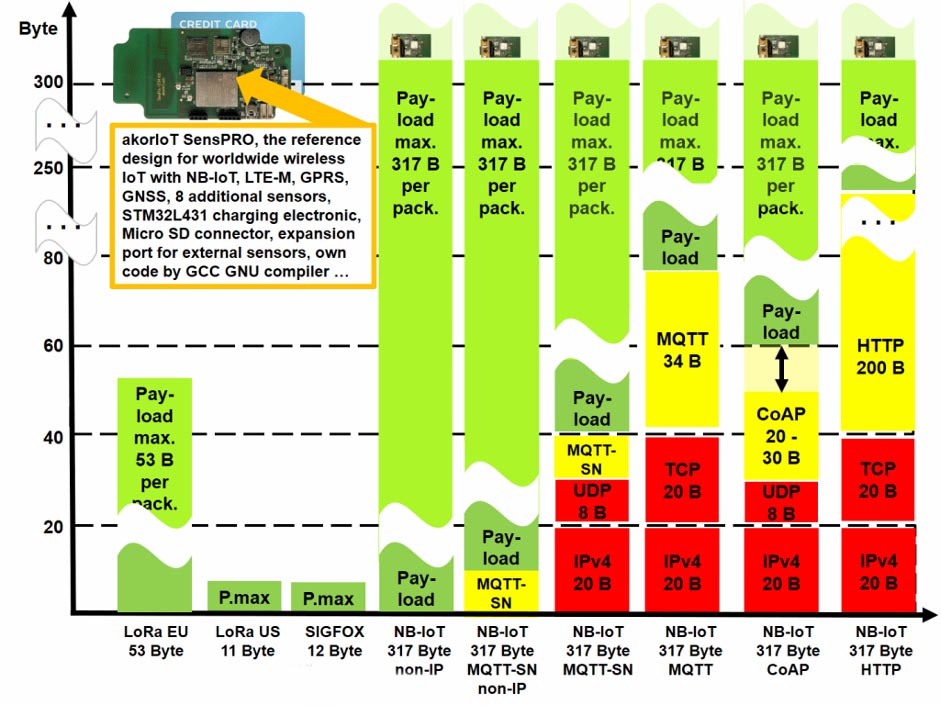
The main difference between MQTT-SN and CoAp is that the former requires a broker. This means that its client nodes have less complexity, however the need for a broker could make a system more complex to integrate into an existing infrastructure. Overall energy requirements are similar as both work over UDP (see: Performance Evaluation of CoAP and MQTT_SN in an IoT Environment Mónica Martí, Carlos Garcia-Rubio and Celeste Campo. 13th International Conference on Ubiquitous Computing and Ambient Intelligence UCAmI 2019, Toledo, Spain, 2–5 December 2019)
The above graphic shows the number of bytes required to transmit a message. The red area shows the necessary protocol overhead of the carrier: TCP/IP or UDP/IP. TCP/IP specifies that the telegram must be acknowledged automatically after transmission. If the transmission is negative or there is no acknowledgement, TCP/IP repeats the message several times automatically. However, if the acknowledgement is impossible for technical reasons, TCP/IP burns energy and bandwidth unnecessarily.
NB-IoT is quite a new radio technology, however, data was transmitted via radio before NB-IoT. A praiseworthy example is 802.15.4 with 6LoWPAN. 6LoWPAN is a transmission protocol on IP (PPP) and was specified for radio and wired communications by small low powered devices. The layer above it is UDP (not TCP). If a radio channel is disturbed, then it generally makes no sense to start a new transmission of the telegram. UDP does not send an acknowledgement and does not expect an acknowledgement. If you elect to use UDP, then the acknowledgement must be done in the protocol layer above it. The protocol layer above UDP is usually CoAP in the case of 6LoWPAN, CoAP requires that a telegram is sent (with or without acknowledgement). This means that the programmer himself can decide whether he needs an acknowledgement or not. We serve a customer who has been using GPRS for over ten years and transmits his position data with a proprietary protocol based on UDP. 98% of his sent messages reach the server. Since the customer transmits every five seconds, the loss of a single message is unimportant. If you transfer this thinking to your design and use CoAP, then you can confidently do without the receipt, because 98% of the sent messages will arrive on the server. LWM2M is a protocol from the Open Mobile Alliance and is a layer above CoAP.
The structure as a glance
PPP => UDP/IP => CoAP => LWM2M
PPP => UDP/IP => MQTT-SN => not defined
PPP => TCP/IP => MQTT => not defined
In the akorIoT Group, we decided to use CoAP and defined the protocol layer above it ourselves. In addition, we have chosen an encryption method that is extremely secure and thus avoids the risk that third parties can read our data traffic. The encryption is from end-to-end and therefore neither the NB-IoT network operator nor other bad guys can read our communications.
The most convenient way with the highest energy waste is HTTPS with the JASON open standard file format. The most inconvenient way with the lowest energy consumption is NB-IoT NON-IP with its own protocol. It is also the way with the most barriers because NON-IP is not supported by all network operators. If you plan a local product for example only for Germany then you can use NON-IP without problems. If you plan like the akorIoT GROUP does Internationally, then NB-IoT with CoAP is a good approach. Whether you then use LWM2M as an application layer above or your own protocol layer, is up to you. LWM2M is a convenient approach, because not only the profiles of the telegrams are regulated there, but also the login to the server and the device management. LWM2M can also be used with SMS or based on LoRaWAN. The latest version of LWM2M is supporting TCP/IP as well.
The net is that CoAP does not expect an acknowledgement, or CoAP accepts an acknowledgement with extremely long elapsed time. By contrast, long acknowledgement coupled with TCP/IP and its compulsion for receipts resulting in multiple resends will be the death of your battery.
I hope, I could bring a little light into the darkness with my graphics. Unfortunately many people still confuse the bearer and the protocol layers above the bearer. I, therefore, recommend that you take a quick look at the OSI layer model even if the TCP/IP or UDP protocol does not follow the layer model exactly.
The post Which IoT protocol do I use? Here is the answer appeared first on akorIoT.
]]>The post Which LPWAN do you use for an emergency call button? appeared first on akorIoT.
]]>
First of all, we have to establish whether the mobile emergency call button is to be used locally in a building, on a company campus, or nationwide in a European or a non-European country. In this article, we will limit the use of the mobile emergency button to Germany however, this local design can easily be transferred to other countries.
A Nationwide mobile emergency call button for Germany
For a nationwide mobile emergency call button for Germany, NB-IoT with a fallback to GSM is currently the best for future-proofing. Since April 2020 national roaming for NB-IoT has been available in Germany from Deutsche Telekom and Vodafone. The emergency call device therefore has access to two parallel but independent NB-IoT networks. Furthermore, there are now very inexpensive NB-IoT modules offering GSM fallback. With the addition of GSM such an emergency call system can access three independent GSM networks and as a result an NB-IoT/GSM combination module can achieve a fivefold network redundancy in Germany.
Emergency call button locally on a company campus
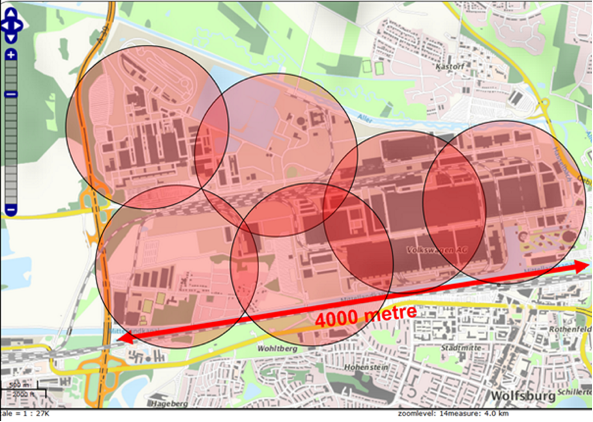
If a mobile emergency call system is needed locally on a company campus or in a building, LoRaWAN is a suitable solution. LoRaWAN offers us inexpensive gateways including an antenna for outdoor installation for about € 500. The frequency range for LoRaWAN is license-free in Germany. For the Volkswagen plant in Wolfsburg, fewer than ten gateways are needed to cover the entire plant area including inside the buildings.
Indoor emergency call button with localisation
If you need a mobile emergency call button which also offers a localization via the field strength in the building, Neocortec with its SubGHz Meshnet is suitable. With Neocortec the radio network is built up completely independently. Each node is also a router. Due to the high link budget and the good penetration through walls, only a few permanently installed nodes are necessary to cover a building completely. These permanently installed nodes are called anchors. Each mobile node synchronizes every second up to every 30 seconds with 3-12 neighbouring nodes. The field strength is also transmitted to the neighbours during synchronization. The gateways in such a SubGHz Meshnet cyclically receive the field strength values of the nodes to their neighbours. Since the locations of the anchors are known, the approximate location of the mobile nodes can be calculated.
During a test in our office in Munich, we established a radio link from the meeting room on the left side of the building to the offices on the next higher floor on the right side of the building. In doing so, we passed the floor/ceiling and four walls and still had plenty of link margin-left.
For a mobile emergency call system in a building or on an oil platform I would recommend SubGHz Meshnet. If you limit the number of neighbours to three and set the synchronization time to 30 seconds, a radio module from Neocortec works on two standard AA cells with 2500 mAh for 7 years including 170 messages per day with 21-byte user data per message.
Each message from a node to a neighbour is acknowledged at the node. This means that an alarm message is acknowledged from end-to-end. In addition, cyclic synchronization means that the gateway knows which nodes are located in the network. If a node fails to appear during synchronisation several times, the node has been lost or has left the network. If you compare this with NB-IoT and LoRaWAN, you will find that there is no cyclical synchronisation of the stations in the network. A missing subscriber is not detected and a failed emergency call button does not work anymore and cannot transmit a message in case of emergency.
This unique SubGHz Meshnet changes the radio channel with every connection and hops across all the European 868 MHz bands. If a packet is lost during transmission to a neighbour because the radio channel used is interfered with, the message is repeated on another radio channel. The radio module selects the 3-12 neighbours randomly. If 50 participants are visible in a radio network with 500 participants, then the participants with the highest field strength are not selected but a random selection is made. This means that two or three participants in the same room may see the same 50 neighbours but select their route to the gateway completely differently. Since all 500 participants in the network do this, the radio network is very evenly balanced.
A combination of SubGHz Meshnet and a NB-IoT/GSM combination module provides perfect indoor coverage including automatic detection that the subscriber is no longer present in the SubGHz network plus perfect fivefold redundant coverage outside the building or company campus.
Emergency call button with other LPWAN technologies
In the LPWAN Cookbook, the author compares the well-known LPWAN technologies NB-IoT, LoRaWAN and in addition to SubGHz Meshnet and comes to the conclusion that in many cases SubGHz Meshnet from Neocortec needs less energy and has a much higher operational reliability.
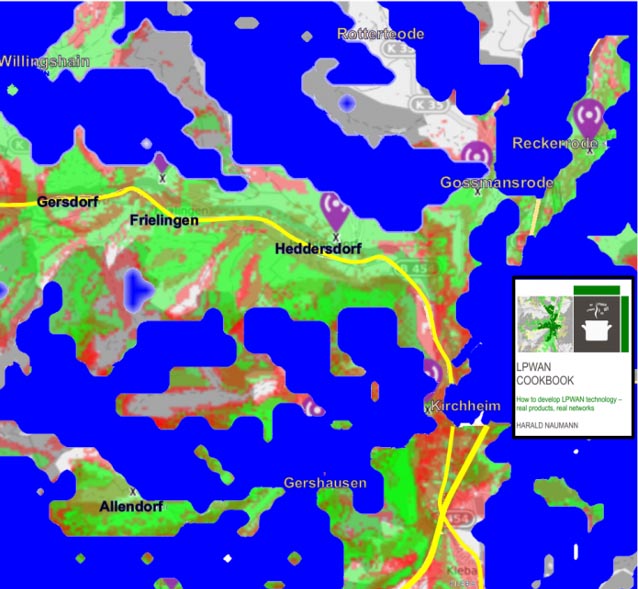
In the community of Kirchheim with its twelve villages, none of the villages is completely covered by Sigfox indoors (blue area). But in all twelve villages you can make a phone call with your GSM phone. In addition, in the community of Kirchheim, both NB-IoT network operators offer more or less good network coverage. A SubGHz Meshnet distributed over all twelve villages for 3600 inhabitants in many houses is probably not economical. In order to guarantee a connection, every second or even third streetlight would have to be equipped with an base station. If all streetlights are equipped with a SubGHz Meshnet from Neocortec to monitor the function of the streetlights and to send control commands, this existing Meshnet could be used for other tasks like an emergency call system.
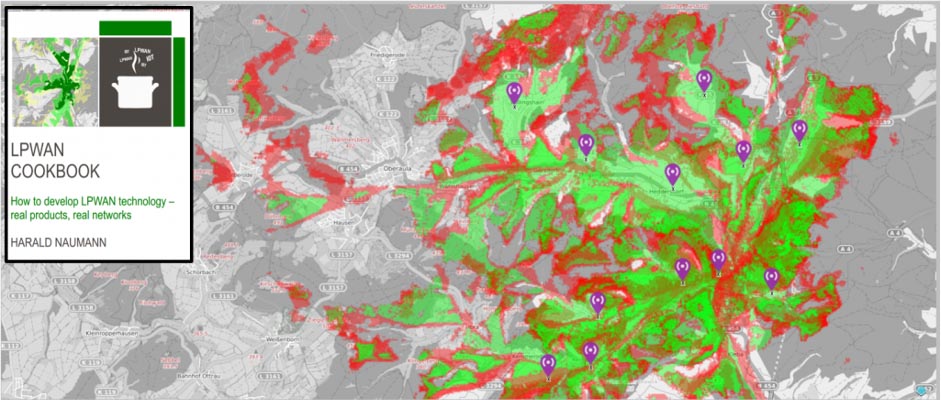
Twelve gateways worth € 500 installed by the voluntary fire brigade would be economical if enough participants in Kirchheim wanted to use the private LPWAN. However, NB-IoT and GSM already offer five-fold redundancy at most locations without the need to install a new network. NB-IoT, GSM and also LoRaWAN offer the possibility to acknowledge an emergency call as often as you like per day. Sigfox works in the upload without automatic acknowledgement and offers in the download only four messages with 8-byte acknowledgement per day. Sigfox, therefore, offers the worst network coverage for the community of Kirchheim and, on top of that, the most insecure connection quality, because you have to do without the acknowledgement of the message after four messages per day. I can therefore not recommend Sigfox for emergency call applications.
The post Which LPWAN do you use for an emergency call button? appeared first on akorIoT.
]]>The post Certifying your IoT device appeared first on akorIoT.
]]>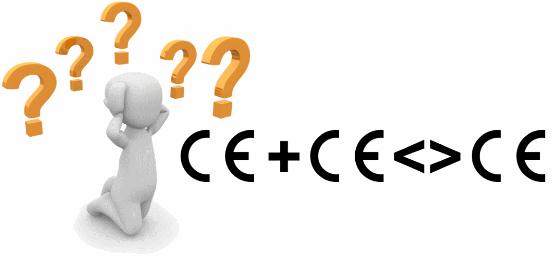
The CE Radio Equipment Directive 2014/53/EU (RED) certification only applies to the radio module and is not transferred to the complete circuit board with the enclosure. You will have to test again, but only a subset of the tests already passed by the GSM module.
Re-testing is necessary because a badly designed antenna with a poor return loss will generate a lot of harmonics, it may not transmit in the correct frequency band will have high energy consumption and in extreme cases the harmonics can damage the radio module. Harmonics can also be generated even when using a high-quality chip antenna if it is poorly placed on the PCB, with too small a ground plane or with bad platinum layout (DP question I don’t understand this). If you don’t have any design experience or measurement equipment (such as a MegiQ Vector Network Analyser), it is difficult to evaluate the performance of an in-house designed PCB antenna and either redesign it or correct the impedance with a matching circuit.
If you lack the necessary experience, don’t worry! Even experienced radio designers can struggle with the requirements of IoT radio design. To be on the safe side, we recommend a modest investment in the time of an experienced external consultant from the arkorIoT team for at the start of your antenna journey. A consultation with report often costs only 3 to 4 hours working time and saves thousands of Euros in radio certification mishaps.
Below is a summary of the arkorIoT team’s available wireless IoT related services:
- Impedance matching of the antenna in the device (chip, PCB antenna, helical antenna)
- Guidance on antenna design if undertaken by the client
- Antenna layout of the dual F-antenna on an empty PCB in the customer’s enclosure
- Antenna layout of any other custom PCB antenna type: helix antenna, Flex PCB antenna, antenna punched from tinplate, antenna printed on plastic in housing, antenna on ceramic, slot antennas and many more techniques
- Antenna with radio module and power supply for extremely low power consumption
- Assisting in the implementation of the antenna or power supply concept on the fully-featured PCB of the customer
- Development of the whole PCB including an antenna with software development by the customer
- Development of the whole device (HW + SW) following the client’s specifications
- Licenses to reference designs for NB-IoT, LTE-M, GSM, GNSS, BLE, Wi-Fi, MCU, sensors and charging electronics. Over 20 application examples are provided with an open block diagram and the possibility for customers to develop their own code using a free C compiler
- Preliminary measurements and tests required for radio certification
- Radio certification according to RED (CE), FCC and several more standards
- Workshops at the client’s office or via video conference
- Training and seminars on radio technology and radio certification
The post Certifying your IoT device appeared first on akorIoT.
]]>The post Request for an NB-IoT antenna appeared first on akorIoT.
]]>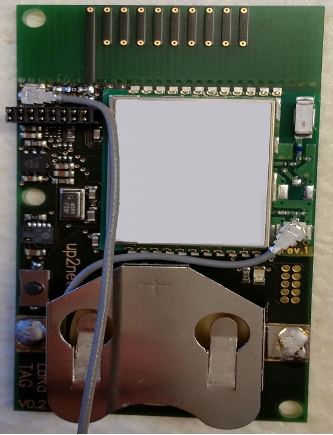
Another request for a custom PCB antenna for NB-IoT. Since we invested in NB-IoT early on, we can bring a lot of experience. Simply taking over a layout of an antenna for an unlicensed band like LoRaWAN (868 / 915 MHz) usually does not work. It may be sufficient for first tests but if the antenna bandwidth of the NB-IoT antenna does not fit, this usually leads to harmonics and a negative result for the radio certification.
Request for NB-IoT antenna via LinkedIn:
Hi Harald, Thanks for the industry knowledge you share on here. Lots of useful information. We’re in the process of deploying our NB-IoT solution in the UK but are waiting for coverage to catch up. I have already designed a PCB, with an OTS antenna and integrated PCB antenna (similar to TI’s helical design) I must consult with you before our next PCB redesign as we’re looking to reduce the overall cost of the system. Regards
Answer to the NB-IoT customer:
Thanks for the kind words.
My recommendation is always to first build a prototype with an empty PCB in the original case. If you don’t have the empty case yet, you can cut it out of plastic plates of the same material and glue it together. 3D Printing is only possible to a limited extent because not all plastics can be printed. If you print ABS, you have to print it fully (no combs in print) because the epsilon R of the plastic and the thickness of the plastic influences the antenna. For more information see the IoT/M2M Cookbook.
Since we work with various manufacturers of external antennas we can also offer you the manufacture of the injection tool up to the production of the whole device. If your device is mounted on a street lamp, then you need a UV-resistant plastic. Antennas for roof mounting on cars are UV-resistant. We are thus well prepared for the practical use of your design.
The PCB antenna from TI will probably not provide the necessary frequency bandwidth for band 8 and band 20 in the EU. In the USA the lowest frequency goes down to 620 MHz. In Australia up to approx. 690 MHz. We can cover more about this in a Kick-Off meeting via Skype with a presentation of a few slides.
The typical engagement with the arkorIoT team is as follows:
- Purchase of the IoT M2M Cookbook, read the book and learn the basics.
- Telco/Skype to kick off the project (approx. 4 hours working time with preparation and follow-up)
- Prepare an empty board with an antenna in the original case. Often also with the radio module and USB cable for live testing.
- Measurement of the Radiation Pattern in 3 axes (recommended option)
- Delivery of the documentation incl. Gerber Files
- “Copy” of our design by your team with all components
- Design review by our akorIoT team or accompaniment of the development by phone, Skype or e-mail
- Production of prototypes and matching of the antenna by our team
- Mostly then up to 10 further versions up to the serial board required
- Measurement of the serial PCB and re-matching of the antenna
- Pre-tests for radio certification in our laboratory and in the test laboratory
- Possible adjustment of the matching network and Worst-Case modification of the PCB (very rare)
- Radio certification of the device and accompaniment by the akorIoT team. We are always in the room during the measurements and check whether the measurements are correct in the test laboratory. Measurement errors lead to a negative test report.
If required, we can develop the series PCB on the basis of the customer’s prototype (pre-production) and take care of the radio certification. The software development is then still with the customer. If required, we put together the “all-round carefree package” and develop the hardware plus firmware, plus software on the server and app on the smartphone.
Since we have extensive experience with NB-IoT projects and development of antennas, we would like to guide and support your project and we are happy to make you a commercial offer. We need a sketch or drawing of the case with dimensions to be able to estimate the size of the board. If the board is too small compared to the wavelength of the lowest frequency, the development costs will increase. In the worst case, no antenna can support the application in this format.
Extract of wireless IoT related services:
- Matching of the antenna in the device (chip, PCB antenna, helical antenna)
Guidance on antenna design if undertaken by the client - Antenna layout of the dual F-antenna on an empty PCB in the customer’s enclosure
- Antenna layout of any other custom PCB antenna: Helix antenna, Flex PCB antenna, Antenna punched from tinplate, Antenna printed on plastic in housing, Antenna on ceramic, Slot antennas and many more techniques
- Antenna with radio module and power supply for extremely low power consumption
- Assisting in the implementation of the antenna or power supply concept in the fully-featured PCB of the customer
- Development of the whole PCB including an antenna with software Development by the customer
- Development of the whole device (HW + SW) following the client’s specifications
- Reference designs with NB-IoT, LTE-M, GSM, GNSS, BLE, Wi-Fi, MCU, sensors, charging electronics for over 20 applications with an open block diagram and the possibility for customers to develop their own code using a free C compiler
- Preliminary measurements and tests required for radio certification
- Radio certification according to RED (CE), FCC and several more standards
- Workshops at the client’s office or via video conference
- Training and seminars on radio technology and radio certification
We look forward to receiving your inquiry. In most cases the IoT M2M Cookbook or the reference design akorIoT SensPRO is only the beginning. After that there are often follow-up orders for the services mentioned above. “akor” is the ancient Celtic word for “open” and we prefer openness in our concepts, and like to share our knowledge in training and to maintain open communication with our customers.
The post Request for an NB-IoT antenna appeared first on akorIoT.
]]>The post Can you fit NB-IoT into a matchbox? appeared first on akorIoT.
]]>Can you fit NB-IoT into a matchbox?
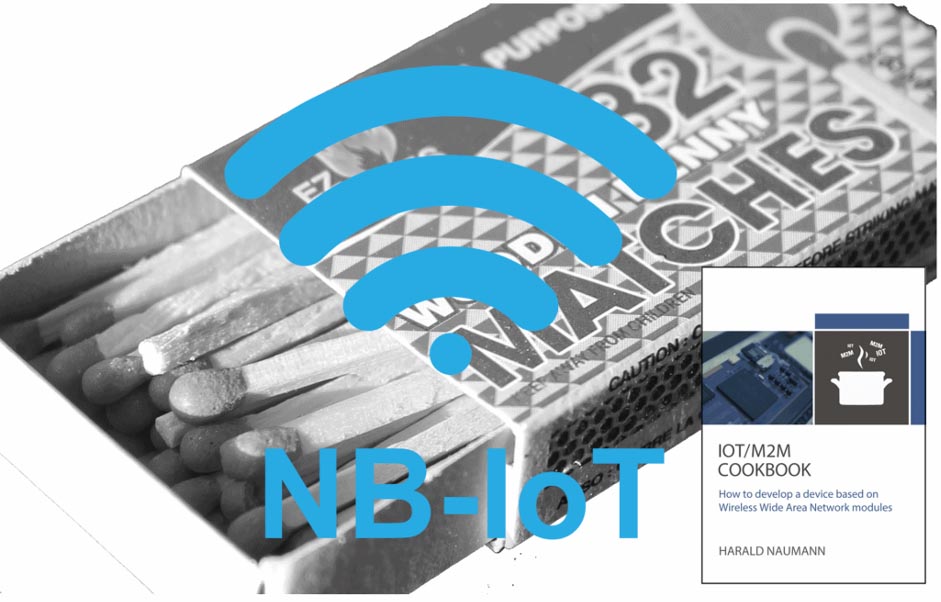
We received a request for an NB-IoT device in a matchbox. It is of course not an actual matchbox but similar in size. Small NB-IoT devices with batteries operating in the frequency range from 600 MHz to 1000 MHz are the premium class of IoT devices. I don’t want to mention the question and the application in detail as it is a commercial project. We can probably solve the problem and if it can be solved we will know from studying the test setup described below.
Answer to the NB-IoT customer:
Thank you for providing further details. Part of the answer to the NB-IoT related questions can be found in my IoT M2M Cookbook. You should read this first. In order to assist you in parallel to purchasing the book we would need an order for 4 hours working time comprised of 3 hours preparation including further links and references to literature, chapters in the book and 1 hour for arrangements by email/phone.
You must consider conductive materials near the antenna. In advance we can already say with respect that we see a typical beginner’s mistake. You have chosen a very small case first and considered the antenna at the end of the design process. In the IoT M2M Cookbook, in my blog and in our lectures we repeat and stress that you should first choose the case and antenna and then move on to the rest of the circuit. If the antenna concept doesn’t work or is impossible, you can stop the project and save yourself trouble and expense. Nobody can defy the laws of physics.
For your requested design we see a chance for success, but we will only know if it can work after a test setup in the original case. The smaller the device the more time you need for the implementation. For boards in the size of Lambda/4 length of the lowest transmission frequency we need about 6 working days +/1 day with multiple setups in FR4 in the laboratory, ordering the boards from the manufacturer and documentation. Often the PCBs for PCB track antennas have to be ordered several times from the manufacturer to achieve a working design. We mechanically adjust the first series of PCBs on the workbench and this change will then be adopted in the next series of test samples. The result is then handed over and the customer takes over the rest of the circuit design. We stay in touch during the development of the first PCB sample of the customer and review, so that no beginner errors develop. If desired, we also accompany the customer afterwards. This PCB is then measured and documented again by us. The customer can then produce the samples. Ten PCB versions up to series production are not uncommon. Before it goes into certification and mass production, we check and measure again. Before we go into radio approval, we do a few pre-tests in the test laboratory. This avoids unnecessary costs.
Based on the questions asked of us we can see that the customer lacks experience in the integration of antennas and radio-based devices. Our recommendation is therefore to have the PCB developed by an external company. We can take over the development of the PCB and the antenna and you can also develop the firmware for the IoT device and the server or app on the smartphone. If desired everything can be compiled by us. We are flexible in the division of the necessary tasks.
Extract of wireless IoT related services:
- Matching of the antenna in the device (chip, PCB antenna, helical antenna)
Guidance on antenna design if undertaken by the client - Antenna layout of the dual F-antenna on an empty PCB in the customer’s enclosure
- Antenna layout of any other custom PCB antenna: Helix antenna, Flex PCB antenna, Antenna punched from tinplate, Antenna printed on plastic in housing, Antenna on ceramic, Slot antennas and many more techniques
- Antenna with radio module and power supply for extremely low power consumption
- Assisting in the implementation of the antenna or power supply concept in the fully-featured PCB of the customer
- Development of the whole PCB including an antenna with software Development by the customer
- Development of the whole device (HW + SW) following the client’s specifications
- Reference designs with NB-IoT, LTE-M, GSM, GNSS, BLE, Wi-Fi, MCU, sensors, charging electronics for over 20 applications with an open block diagram and the possibility for customers to develop their own code using a free C compiler
- Preliminary measurements and tests required for radio certification
- Radio certification according to RED (CE), FCC and several more standards
- Workshops at the client’s office or via video conference
- Training and seminars on radio technology and radio certification
We look forward to receiving your inquiry. In most cases the IoT M2M Cookbook or the reference design akorIoT SensPRO is only the beginning. After that there are often follow-up orders for the services mentioned above. “akor” is the ancient Celtic word for “open” and we prefer openness in our concepts, and like to share our knowledge in training and to maintain open communication with our customers.
The post Can you fit NB-IoT into a matchbox? appeared first on akorIoT.
]]>The post Recertification requirements for an off-the-shelf module appeared first on akorIoT.
]]>Q: I have a question for you. It can be assumed that my new product contains a certified GSM module and is connected to a PCB antenna I developed. If my device is to receive CE certification, does it need to be fully re-tested? Will my custom PCB antenna cancel the wireless module certification?
Answer about certification and antenna
A: The CE (RED) certification only applies to the radio module and is not transferred to the complete circuit board and enclosure. CE +CE ≠ CE. You will have to test the final configuation, but only a subset of the tests already passed by the GSM module on its own.
With a badly designed antenna with a high Return Loss, harmonics can be generated quickly. Also, even a good chip antenna that is incorrectly integrated, for example with a ground plane that is too small or with a poor layout may also lead to harmonics.
If you don’t have any experience or measurement equipment (Vector Network Analyser), it is difficult to evaluate a self-made PCB antenna. If you are lacking experience then we recommend using an external antenna consultant. A consultation with report often costs only 3 to 4 hours working time and saves thousands of Euros in repeated attempts at radio certification.
Extract of wireless IoT related services from the akorIoT team:
- Matching of the antenna in the device (chip, PCB antenna, helical antenna)
- Guidance on antenna design if undertaken by the client
- Antenna layout of the dual F-antenna on an empty PCB in the customer’s enclosure
- Antenna layout of any other custom PCB antenna: Helix antenna, Flex PCB antenna, Antenna punched from tinplate, Antenna printed on plastic in housing, Antenna on ceramic, Slot antennas and many more techniques
- Antenna with radio module and power supply for extremely low power consumption
- Assisting in the implementation of the antenna or power supply concept in the fully-featured PCB of the customer
- Development of the whole PCB including an antenna with software Development by the customer
- Development of the whole device (HW + SW) following the client’s specifications
- Reference designs with NB-IoT, LTE-M, GSM, GNSS, BLE, Wi-Fi, MCU, sensors, charging electronics for over 20 applications with an open block diagram and the possibility for customers to develop their own code using a free C compiler
- Preliminary measurements and tests required for radio certification
- Radio certification according to RED (CE), FCC and several more standards
- Workshops at the client’s office or via video conference
- Training and seminars on radio technology and radio certification
The post Recertification requirements for an off-the-shelf module appeared first on akorIoT.
]]>